
101. Beehives and More
- Jerome Kocher
- Sep 8, 2025
- 5 min read

Dotted throughout the Dingle Peninsula are stone beehive structures built by early farmers for animal quarters below and human sleeping above. Without mortar, these rounded structures of dry stone had thick walls that tapered inward, thrusting the supportive tension outward toward the base and utilizing a capstone on top, like a keystone in an archway. Miraculously, they don’t leak water.
Some beehives have extensions into smaller beehive chambers with removable stones on the threshold into which children could be safely hidden for protection. They would crawl down into even smaller and deeper sub earthly niches when danger threatened from outside.


You will also find “ring forts,” not defensive forts but stone ring foundations from previous beehives. In the past these have been considered a sacred place for the fairies, nature spirits, not to be used or disturbed. One of my guides explained that only a few decades ago his grandfather would only allow his cows to graze there once a year, then milk those same cows, and pour the precious milk back into the soil of the ring as an offering to the elemental spirits living there.

This pantheistic awareness of Nature spirits is quite strong in Irish history. Some will include the sun worship with these pre-Christian sensitivities. The Celtic cross with a circle embracing the Latin cross was St. Patrick’s effort to merge the two belief systems. It may also show a progression in consciousness from one to the other, from the Sun to the Son.

The development of language has also left ruins. Ancient stone markers in Ireland show a written phonetics based on horizontal and diagonal lines cut into the stone’s edge. Before the influence of alphabetic characters these were etchings of vowels and consonants. For example, in the progression of the five vowels, three lines would represent the third vowel. Many of these were land markers in a paternalistic society indicating the male lineage of the residing chieftain. Namely, this is the territory of the son of someone who is the son of . . . and so on. The naming of the familial or tribal clan gave one an identity, not as an individual consciousness but as a group soul.

We still have this in many family names today with examples of O’Neill or O’Sullivan reminding us this person is “of” the Neill or Sullivan clan. It’s the same with the prefix “Mac” as in MacDonald. From Scandinavia we may have Andersson, meaning the “son” of Anders. Or many names can indicate a profession, such as “Smith,” or in my case “Kocher,” from the German root for “a cook.” Whether an indicator of a bloodline or vocational lineage, it reminds us of a time when group identity superseded personal individual identity. Today, people take individuation even further and rename themselves with social profiles or avatars based on their personal identity, even fantasy, not on any group let alone blood bond.

Here there are also ruins of communal Christianity which implemented the beehive structure for living quarters as well as a central “oratory” or place of prayer. Early Christianity in Ireland reveals a consciousness that predates the establishment of the Roman Catholic Church. In Ireland there were no bishops or dioceses, nor a central regulatory control from the Vatican. Each community decided for itself. Religious leaders could be married or not. There was a freedom and self awareness until the 12th century when the Roman Catholic Church put its imprint or foot down on the free spirit life of Ireland.
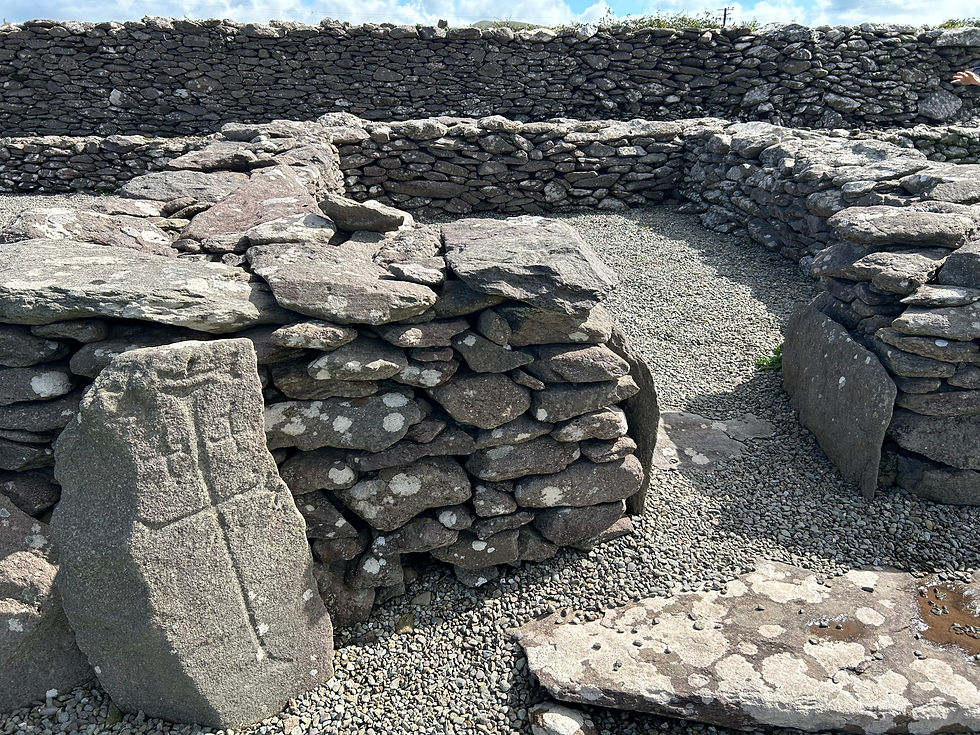
What remains of these early Christian ruins are their familiar round foundations. Many sent emissaries into central Europe and beyond. In Switzerland today, St. Gallen is a city and canton (province) that received its name from an Irish missionary. A cross fertilization of Christianity can be seen going both south and north. Irish Christianity had a term for green, white or red martyrs. The “green” martyrs stayed in communal structures of monasticism dedicated to a harmony of the Spirit at home. The “white” martyrs braved into the adventurous unknown abroad to bring the Good News. And “red” martyrs gave their life blood when being persecuted for their Faith.


There is one communal ruin today that is fully intact. Unlike the round beehive structures, The Oratory of Gallarus, is a rectangular stone structure standing within circular walls that separate the sacred from the secular. “Gallarus” means stranger or pilgrim. Field markers today show the common icon of a long haired figure that is free from the rules and ritual restrictions of the Roman Catholic reach. No tonsure or shaved head here. No icon of a friar or padre branded with the bare scalp of church allegiance to a higher authority. Early Christian Ireland was a free spirit unfettered by the Latin model of central control. No shadow here of an empire ruled by a Roman Caesar or Pope. The human spirit was as free as the land was green, in harmony with itself, not enslaved by a foreign institution of dogma.


Unfortunately, this could not last nor endure. The dominance of the Latin mentality and central authority of the Roman Catholic Church eventually controlled Ireland. What the Roman Empire could not achieve militarily, the Roman Catholic Church did spiritually. Something died. The history of Ireland is a history of being victimized by larger powers of imperialism. After the Church secured its control, the claws of the British Empire followed with political control.
The Irish are rebels. They’ve had to fight or flee. And that brings us to the so called Potato Famine which saw the diaspora of two million Irish and the death of one million more. But it was not a famine. It was a controlled “hunger” forced on them politically. They call it “The Great Hunger.” And that deserves its own story.


Being a "survivor " of Catholicism in the US myself and having seen first hand the hypocrisy of the church, I can appreciate this history...I imagine the Irish people must be very resilient and perhaps their sense of humor has helped them to survive ...as Mark Twain famously said "It takes a sense of humor to get thru life!"