
104. Eight Miles Out to Sea
- Jerome Kocher
- Sep 12, 2025
- 4 min read

The Ring of Kerry is a 110 mile drive around the Iveragh Peninsula. Most everyone makes this journey to see the dramatic coastal scenery of County Kerry. I'm traveling with six others in a small van and that’s our purpose, except for me. I have an additional goal. At the western most tip, eight miles out in the Atlantic, are the Skellig Islands, so called because of their appearance as “spears or spires” being thrust out of the sea. The larger one is Skellig Michael, named after the Archangel Michael. My intention in the middle of our coastal excursion is to take a boat out to circumnavigate the island. Get close, but not land, because that would be too dangerous for me.
Getting off the boat onto the dock in rolling waves can be treacherous. But more of a concern is that I would not be able to climb the steep series of over 600 stone slab steps to the saddle of the island between two rocky peaks. Even if I could go up, coming back down would be a disaster with my balance. There is no handrail, rope or chain for support. There is a photo of an ascending child tied by a rope to its father for security sake. It’s like being tethered to a team ascending Mt. Everest in case someone falls. I am not tempting fate. Instead I will take a boat around the island to view it from a safe distance. I’m sharing some online pictures here to underscore the dramatic features of the island.


But why go? This island was a Gaelic monastic settlement between the 6th and 12th centuries. A handful of monks saw this as the edge of the world on which they could wrestle with the wild elements of nature as well as their own soul being. Their tenacity for survival over generations is a testament to their Faith. What they left behind is now a UNESCO World Heritage Site.
It’s so dramatic that Star Wars director George Lucas chose this island to film certain scenes of Luke Sky Walker meeting his spiritual teacher for his inner and outer battle against the evil Empire. The setting is other worldly. The parallel to the monks is unmistakeable.
But the boat voyage out there is dependent on good weather - no rain nor wind. If the stone carved steps are too treacherous for me to walk, then ocean white caps and squalls of rain can be lethal to the boats. We won’t know until we arrive.
We travel counter clockwise around the peninsula. Stopping at a French Bakery for almond croissants is part of the journey. The scenery is lush and stunning. Mounds of peat are being dried out and seasoned along the roadside. It’s cut from bogs, acidic wetlands where over the ages dead plant life decomposes, often with sphagnum moss. With environmental awareness, it’s now illegal to cut peat for fuel and sell commercially. But on a small scale a farmer may still advertise "quality Irish soil” for sale. The authorities look the other way.


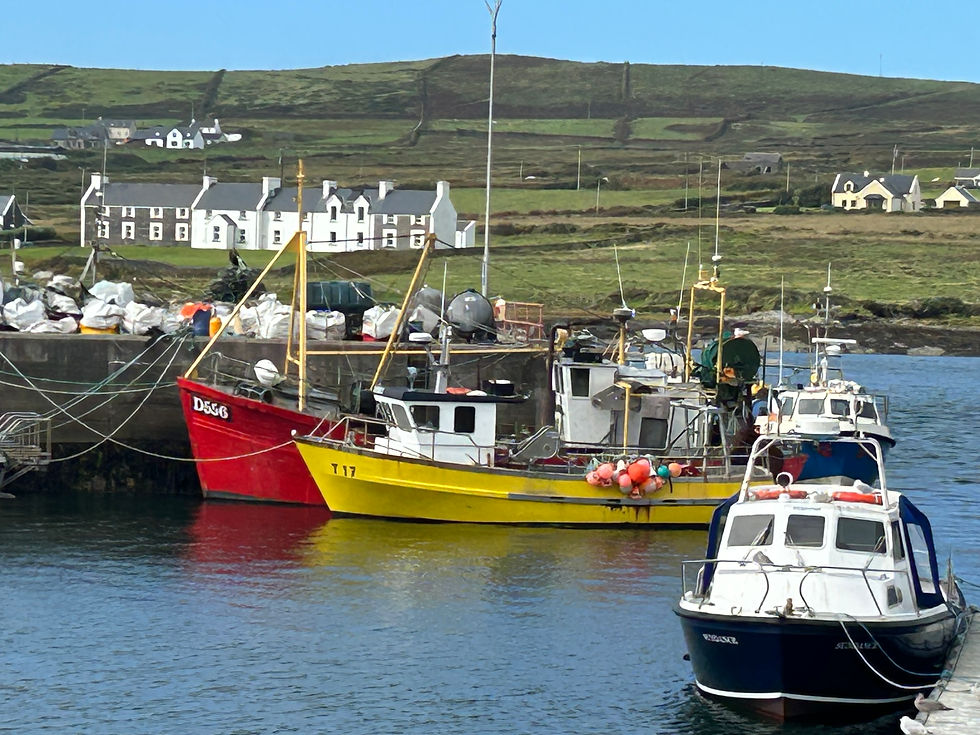
Arriving at the northwestern tip we come to Valentia Island which overlooks Portmagee, a small fishing town. The small bay is guarded by rocks facing the wild Atlantic. In the distant mist, if you look closely, you can see two faint silhouettes on the horizon - Skellig Michael and Little Skellig. Surrounded by heather and tufted grass, the bay begins to darken with grey skies and showers.

The wind picks up. White caps increase. The harbor boats are going nowhere. There’s been no trip to the Skelligs in six days. And today is no exception. No boat for me, today. I will not be following in those medieval footsteps around Skellig Michael.
The closest I’ll get to the Rock is to engage a local roadside farmer who is selling homemade “Skellig" labeled fruit preserves. I buy two, a black currant jam and an orange marmalade with Irish whiskey . It's comfort food for not reaching the Island. But I have the Skellig label in my hand and it reminds me of the misty images on the horizon. Another farmer has his donkey. That’s as close to the 6th century as I’ll get.


Time to re-engage with the purpose of the trip - driving the Ring of Kerry. Heading southwest we come to the dramatic landscape of Ballinskellig’s Bay.

A little further down the road comes a magical surprise of domesticated gardens with many South American plants. This was the estate of Daniel O’Connell, the Liberator, who freed Irish Catholics of penal laws in the 1800’s which restricted Catholics from owning land, holding public office, or practicing their religion. His gardens were the exact opposite of the wild Atlantic coast and the Skelligs. They were a hybrid of jungle and manicured lawns.


We finished the Ring of Kerry by descending from higher elevations past the lake into dramatic scenes of the valley below, back to Killarney. This completed the drive around the Iveragh Peninsula. The rains were returning, and by now Skellig Michael was in the rear view mirror. But I had my jam and marmalade, so I can’t complain.


Comments