
107. Pubs, Churches & Music
- Jerome Kocher
- Sep 19, 2025
- 4 min read
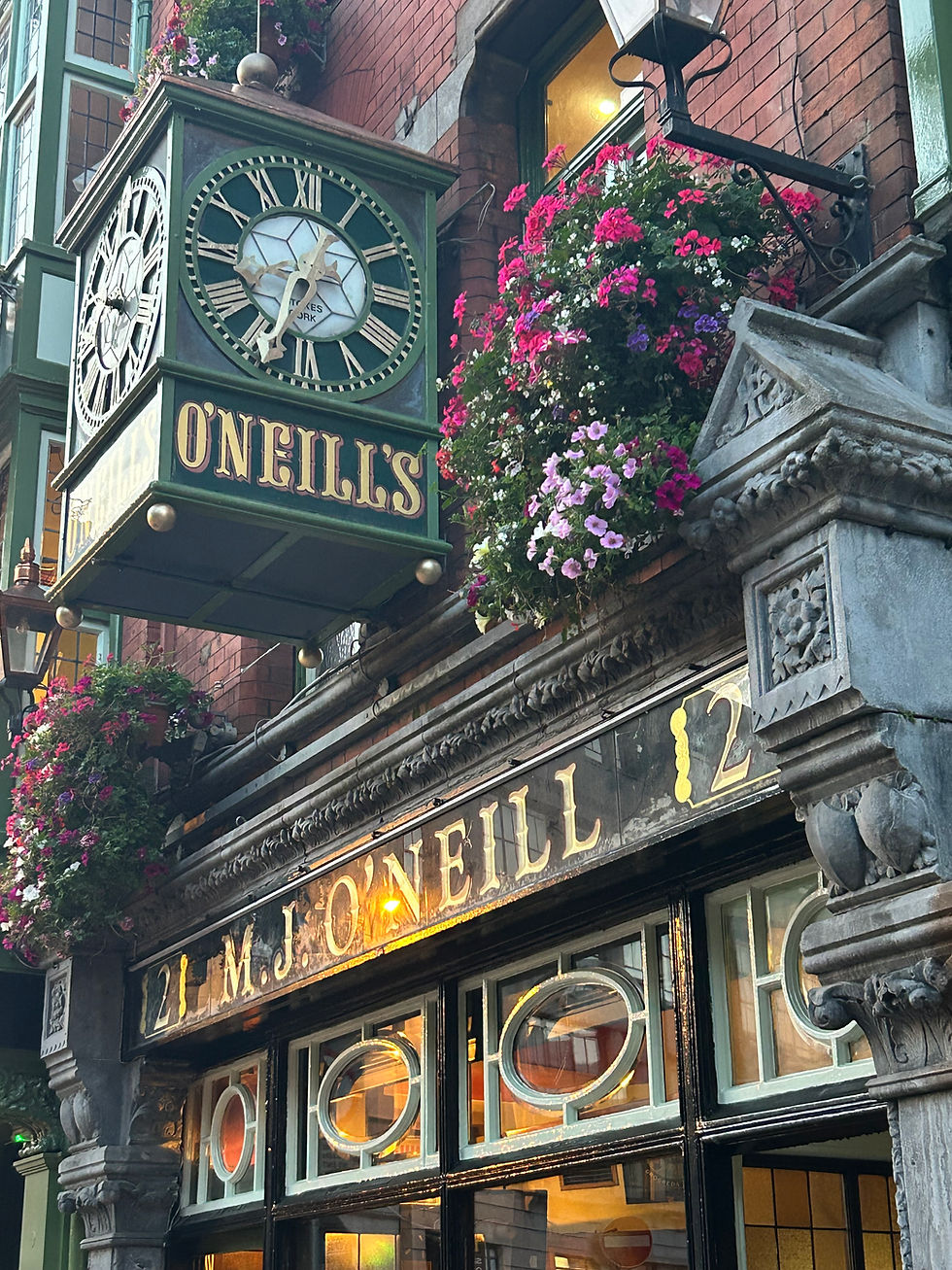
With over 250 pubs in Dublin alone you could argue that more people seek redemption in the public houses than in the churches. “You drink once to remember. You drink twice to forget.”
It’s sort of like a public “communion.” If it’s baptism then the drinking Irish believe in total immersion.

There is one bar though that actually is, or was, a church. Outside there’s the remnant of a church tower and inside is a former nave with stained glass windows at one end and an organ at the other end. In the middle is an elegant oval bar. It’s called the Church Bar and lives up to its name. Definitely more pint than prayer.


The most famous watering hole area is the Temple Bar district. More people take photos or selfies outside than drink inside. And the names of Dublin pubs become more creative the more there are. Like the Hairy Lemon. You’re just not going to find that in the States.


But the two anchors of Dublin religious life are St. Patrick’s Cathedral and Christ Church. Both are deeply rooted historical and burial sites. St. Patrick’s is embedded in a park setting that may be the site of Patrick’s well where he preached and baptized. One of its most famous deans (priest administrator) is Johnathan Swift of “Gulliver’s Travels” fame. He’s buried within, but no one can be exactly sure where. Same for Patrick’s well. Before you get too skeptical, check yourself and ask if you can even remember what you ate three days ago.


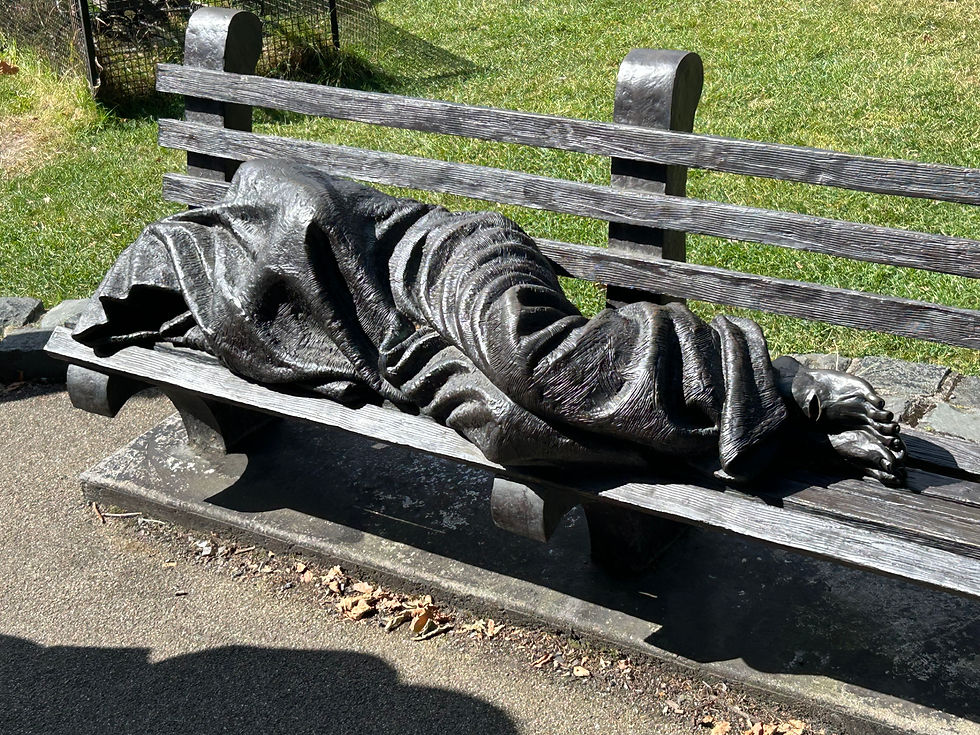
Christ Church has an outreach ministry to the homeless community which is represented by a striking bronze representation of a person sleeping on a park bench. The body is covered and nondescript. But look closely and you’ll see the stigmata on the exposed feet.
All churches and pubs will have music, Just different. I went to Vespers on Sunday afternoon at St. Patrick’s where Evensong Service was sung by a mixed choir of children and male adults. The hour long service with the dress and ritual of Anglican influence was somewhat foreign to my Roman Catholic upbringing. But the music was pitch perfect. Maybe too perfect.
It was hard to relate to. The songs were of militant soldiers for Christ fighting evil in the world. Old Testament passages of Israel fighting for its existence. They were the Chosen people of God. But a half hour later, the priest’s sermon was lamenting the current nation of Israel for bombing civilians in Gaza.
After the Service I introduced myself to one of the priests. I said I had expected this to be Catholic, not Anglican. He correctly reminded me that it was catholic. Just not the Roman version. In fact Anglicans are more catholic (latin for universal) than the Catholics. I said I grew up in that tradition but was non practicing. He could not help himself but proselytize and remind me that I could be a lost soul without the Church. I remained silent because he wasn’t interested in what I do practice. He felt like a salesperson and I wasn’t in the market for a new car or belief. I have one, just fine, thank you.
As good as the choral music was, it can’t compete with the fun of traditional Irish song and dance. Celtic Nights is a dinner and Irish dance show at the Arlington. A lot of audience participation. The night I was there was lively and fun. Since River Dance was away on tour in London, this was the next best thing.


And to top it off, I was fortunate to go one night to Dublin's oldest theatre, the Gaiety. Proscenium stage, gilded mezzanines and balconies that curved around the orchestra and dress circle below. Classic old school. But the performance was anything but that. It was a musical tribute to Ireland’s most popular and famous band from the 60’s, 70’s into the 2000's - The Dubliners. To be honest I had no clue who they were. It would be like going to England and not knowing who the Beatles were. Or to America and not knowing who Willie Nelson, Johnny Cash, Waylon Jennings, Chris Kristofferson and Bob Dylan were. But I had no clue who the Dubliners were.

Five musicians recreated the band's individual personalities as well as their songs, all highlighted by a light show of projected images of the original musicians themselves. But this was not just a performance. It was opening night of a week long tribute to these legends. It was co-created by John Sheahan, one of the surviving leaders of the Dubliners, now in his 80’s. His daughter introduced the evening. Though some of them are no longer alive, their families and their children, and their grandchildren were there in the audience to bear witness to these iconic legends of traditional Irish music with their banjos, guitars, a fiddle, a tin whistle and a flute. And the crowd knew every song. Sometimes sang along. It was an older aged group that grew up with this music in the 60’s and 70’s. And of course the theatre had a bar and most brought their pints back into the performance.

No twenty somethings here. I was among peers, even though I had never heard this music before. Only when I walked home around 10:30 pm down Grafton Street promenade did I see a huge line of younger people waiting to enter a local Club. Fittingly enough, The Dubliner crowd was going home to bed while the younger generation was just starting.
Music. Pubs. Churches. Where some end and the others start, I’m not sure. But it is the “trinity” of Dublin social life. Like the River Liffy, they weave their way through the heart of Dublin.


Comments