
109. The Great Blasket
- Jerome Kocher
- Sep 21, 2025
- 5 min read
It’s early morning in Dingle Harbor. The open air boats are not going out due to rough seas. But our small boat with a cabin cover is ready to go . . . to the Great Blasket Island. Sailing out of the bay we venture past the red sandstone cliffs. A crew member recognizes a Portuguese man-o-war floating near the boat. Past a sculpted rock archway we go out into open sea. It’s rough. Standing in back I get a face full of Atlantic spray. It's strong, even if only for a few seconds, My daily dose of natural sea salt.


West of the Dingle Peninsula lie the Blasket Islands, that were home to an isolated rural community until 1953. If Dingle spoke more Irish than the rest of Ireland, then the Greater Blasket Island spoke only Irish. This small community was separated from the mainland not only by a treacherous Atlantic strait with riptides, but also distinct for their traditional way of life. They would dress their child boys in girls clothing with ribbons in the hair as a disguise to protect them from the fairy Pucas, mischievous nature spirits that were known to kidnap male children. Totally self sufficient, the only thing that stood between them and wild Atlantic nature was their own grit and determination.
When tax collectors from the mainland tried to dock, the islanders would throw stones from the cliff above to discourage their intrusion. It worked. Women were expected to breed, at least ten children. They were the poster community for self sufficiency. But in the 1800’s many of their young women emigrated to Lowell, Massachusetts to work in the textile factories. They’d send money back home to bring the next group. For those who emigrated to America it was a new beginning. For those left behind it was the beginning of the end.
They once had cattle but no bull. They would have to transport each cow by rowboat to the mainland to be serviced. For a barter community, paying for this was onerous. So they bought their own bull for the island. But when he trampled the gardens and wrecked havoc on the island they isolated the bull to a nearby island and again rowed their cows to him one at a time. Once, upon arrival, the Blasket men could not find the bull. He was gone. To their surprise this huge mass of muscle had swum back to the main island to reach the cows himself. He couldn’t wait for the row boats. Later sheep replaced the cattle. More manageable. More submissive. Lighter for the four man row boats.

One of the more famous Blasket women was Peig Sayers who bore eleven children. She became one of the most well known Irish language storytellers, preserving local folklore and mythology. Every Irish student today is obligated to read her biography in the original Irish dialect to help preserve their national identity and heritage. This is much like American students reading Mark Twain’s Tom Sawyer and Huckleberry Finn.
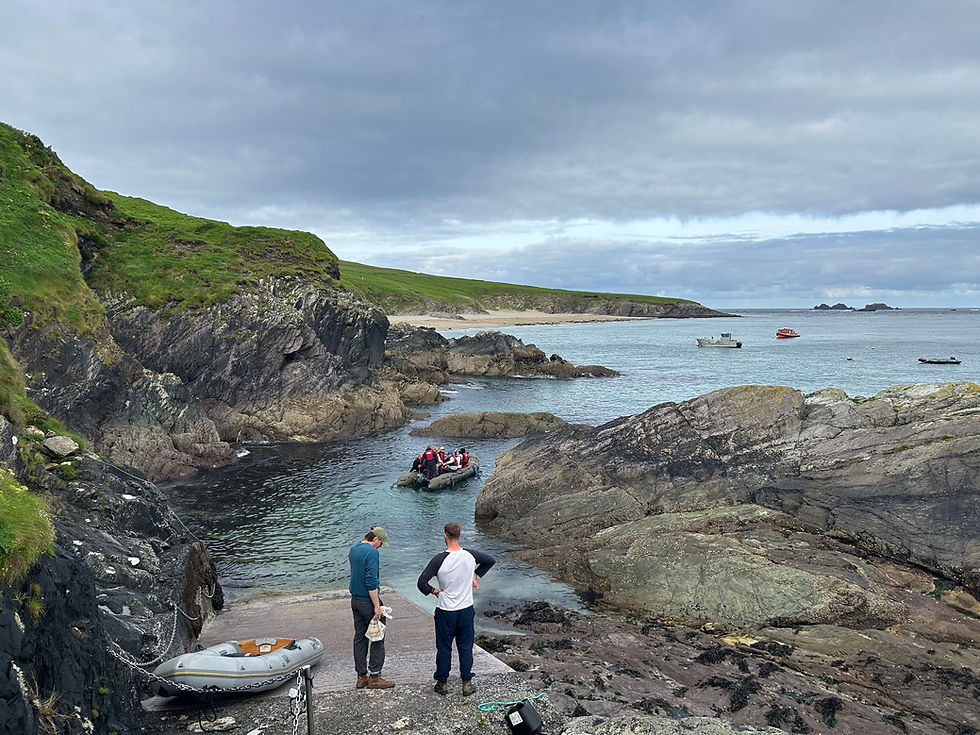
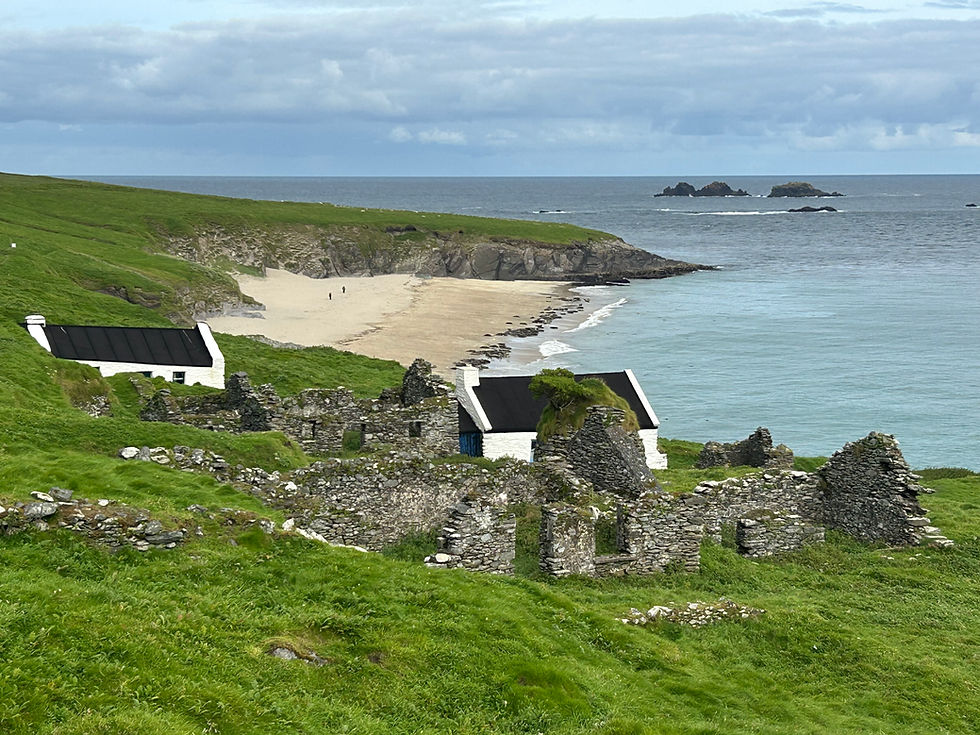
We arrive at the island, but transfer to an inflated dinghy to safely dock in a smaller cove. We are here for 2 1/2 hours to roam and hike the island. A handful of mainlanders own property here. A few of the antiquated stone houses are painted white and meant as simple accommodations for brave travelers. Air BnB without the air. A fireplace is the only source of energy and comfort. I begin my solo exploration. Older stone ruins speak of a harsher existence. One has a stone beehive outside for storage. A tree grows on top.


The most popular destination here is a sandy beach, home to grey seals as a protected breeding ground. Signs direct one to keep a distance so not to disturb. I see two smaller white pups among the lounging mass of dark blubber. One of the pups hugs the surf line as his mother goes out to feed. The females are known to almost starve themselves for the pups, giving all their nourishment up in the form of milk. But at some point they need to replenish.


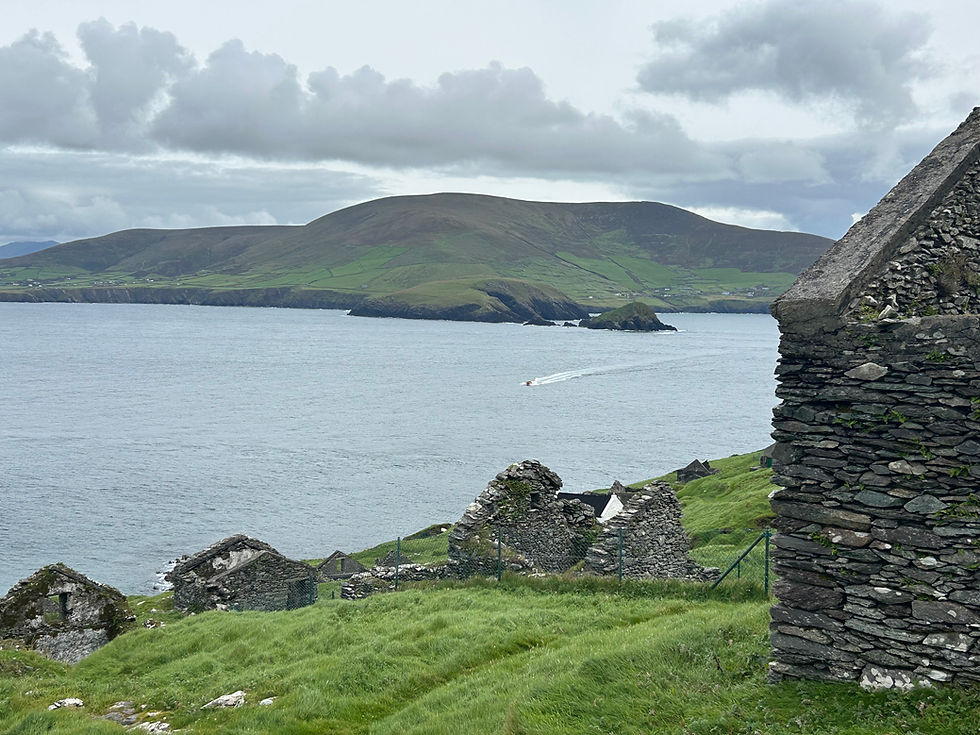
Hiking higher up to the island’s peak there is a loop extending out to a Napoleon watchtower, one of hundreds along the Irish coast put there by the British in the early 1800’s to protect against French invasion. Napoleon never came. But the towers are still there. I hike up along the north side of the island, high enough to see sheep at the far end and the flat island of “the bull” even further out. I'm conscious of time and don't want to miss the last boat. I didn't bring a toothbrush. I didn't bring anything.

The Blaskets have a wealth of literature documenting their life and death existence. The seas were so treacherous that if a boat were to be in danger, there was an understanding not to try and save anyone. Because it was not only futile, but for saving a life the sea would demand that you’d be next. No one romanticized life here. That is only for a current generation that has no clue what life and death can be. As our boat captain said of the islanders, “They were made of stuff that no longer exists.”
On our boat ride back we sight a pod of dolphins playfully escorting the ship. We are not exactly Odysseus returning from the Trojan Wars but we did accomplish what most other boats from Dingle would not attempt today. Large Gannet birds, white with black tipped wings, circle above with up to two meter wing spans. Dramatically, they make backward dives into the water. How they can see and target fish from that height is beyond human perception. But like all animals, they have skills we don’t. And vice a versa.
Our boat is aptly named the Peig Sayers. What could be better for a trip to the Great Blasket. Arriving back at the dock we are greeted by another dolphin, this time a bronze statue of "Fungi," an adopted public relations mascot which had lived in the bay for 37 years. Dingle used to be a sleepy quiet fishing village until Fungi put it on the map for tourists.

The Great Blasket Island is one of the western most tips of Ireland. It was also the edge of civilization on the wild Atlantic coast. The sea gives life. That's true for Dingle. And also for the Blaskets. But on the islands the sea can also take it. A visit to the Blaskets is a step back in time to where men and women were made of much stronger stuff.


Comments